> For the complete documentation index, see [llms.txt](https://docs.rainmad.com/llms.txt). Markdown versions of documentation pages are available by appending `.md` to page URLs; this page is available as [Markdown](https://docs.rainmad.com/resources/house-robbery-with-welding-minigame/inventory-integration.md).
# Inventory Integration
### ✅ ox\_inventory and qs-inventory already integrated with rm\_houserobbery.
## qb-inventory Integration
This guide is for **qb-inventory** 2.0.0. If you are using an older version of **qb-core**, the **AddItem** and **RemoveItem** functions might be located in **qb-core/server/player.lua** or in any of the files within **qb-inventory/server/**.
### Add Item Events to qb-inventory
To add item-related events to `qb-inventory`, follow these steps:
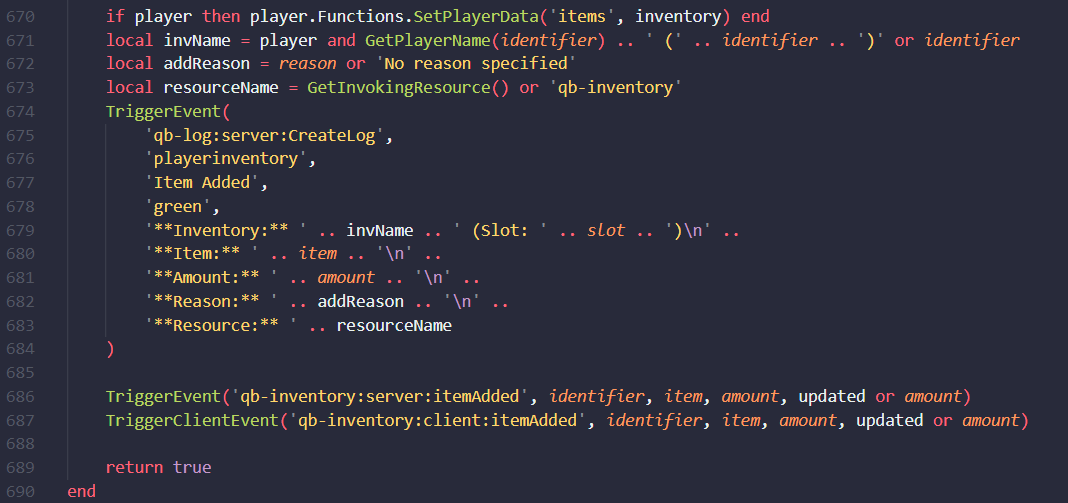
#### 1. Modifying the `AddItem` Function
In the file `qb-inventory/server/functions.lua`, locate the `AddItem` function. To trigger events when an item is added, insert the following code **before** the line `return true`
```lua
TriggerEvent('qb-inventory:server:itemAdded', identifier, item, amount, updated or amount)
TriggerClientEvent('qb-inventory:client:itemAdded', identifier, item, amount, updated or amount)
```
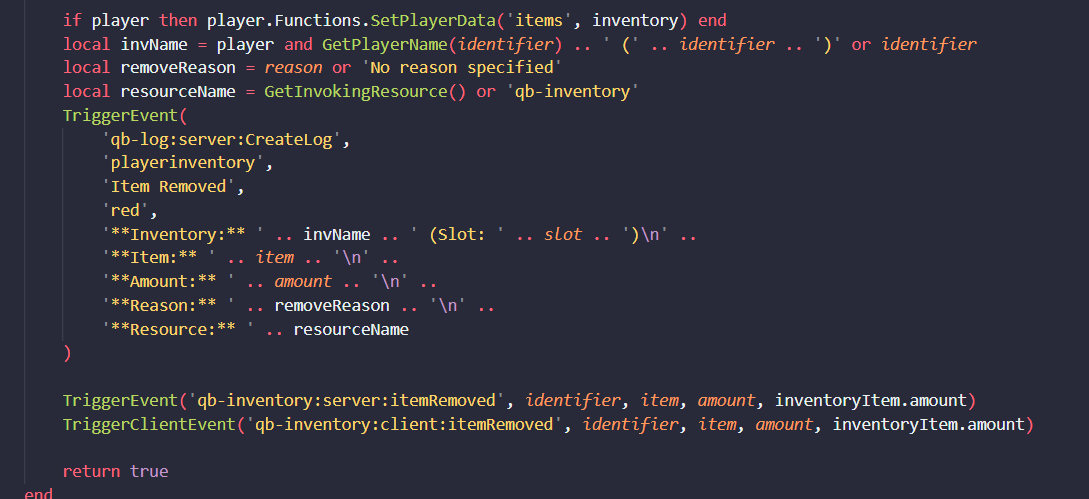
#### 2. Modifying the `RemoveItem` Function
Similarly, locate the `RemoveItem` function in `qb-inventory/server/functions.lua`. Add the following lines of code **before** the `return true` statement to trigger events when an item is removed:
```lua
TriggerEvent('qb-inventory:server:itemRemoved', identifier, item, amount, inventoryItem.amount)
TriggerClientEvent('qb-inventory:client:itemRemoved', identifier, item, amount, inventoryItem.amount)
```
## Custom Inventory
#### Steps to Integrate Your Custom Inventory Script
1. **Assign Events to Functions:** In your custom inventory script, place the events for the `AddItem` and `RemoveItem` functions at the appropriate locations as specified.
2. **Copy and Rename the File:**
* Navigate to the `rm_houserobbery/bridge/inventory` folder.
* Copy one of the existing inventory script files. (like qb-inventory)
* Rename the copied file to match the name of your custom inventory script.
3. **Update Event Names:** Open the newly created file and replace the event names with the ones you assigned in Step 1.
That’s all! You now have your custom inventory script integrate.